Croatia's second city. Wander Diocletian's 1,700-year-old palace walls, swim at Bačvice and lunch on the Riva — back to Dubrovnik for dinner.
Split is the other half of Croatia. While Dubrovnik was a small republic of merchants and stone, Split grew up inside a Roman emperor's retirement palace — Diocletian, who abdicated in 305 AD and built himself a vast fortified villa on the Dalmatian coast to retire in. When the empire fell, refugees moved into the palace walls and never left; today the Old Town of Split is the palace, with shops and apartments occupying the gaps between Roman columns. UNESCO-listed since 1979, it is one of the best-preserved Roman monuments anywhere, and a city of three hundred thousand people lives inside and around it.
From Dubrovnik, Split is a 230-kilometre drive up the Dalmatian coast — three hours by motorway, four by the coastal road if you have time. We default to the motorway northwards and the coastal road for the return, so you see both. The motorway runs through Krka country and the karst plateau; the coastal road threads through Omiš, Brela and Makarska, with the islands of Hvar and Brač offshore the whole way. Both are spectacular.
Arriving in Split mid-morning, we park near the Riva and walk straight into the palace from the seafront. The walking tour covers the substructures (the cool, vaulted basement where the original layout is preserved), the Peristyle (the open-air heart of the palace), the Cathedral of St. Domnius (built from Diocletian's own mausoleum), and the Temple of Jupiter (rebuilt as a baptistery). A licensed local guide can be arranged on request and is highly recommended for first-time visitors — Split rewards context.
Lunch is on the Riva promenade or at a quieter konoba a couple of streets in. After lunch the choice is yours: a 20-minute walk up Marjan hill for a panoramic view of the city, a swim at Bačvice beach (Split's small sandy bay, walkable from the centre), or a wander up to the Fruit Square and the back streets where locals actually live. We can also extend with a stop at Trogir — a UNESCO-listed island town fifteen minutes back south — for the trip home.
The drive back is three hours on the motorway or four on the coastal road, with the option of one swim stop somewhere quiet along the way. You arrive in Dubrovnik between 7 and 8pm, having had a real day in another Croatian city. For repeat visitors to the country, this is often the best of our trips — a different Croatia, on the same coast.
A sample day — your private driver will adapt timings to suit your group on the morning. Linger longer, skip a stop, swap a viewpoint. The schedule belongs to you.
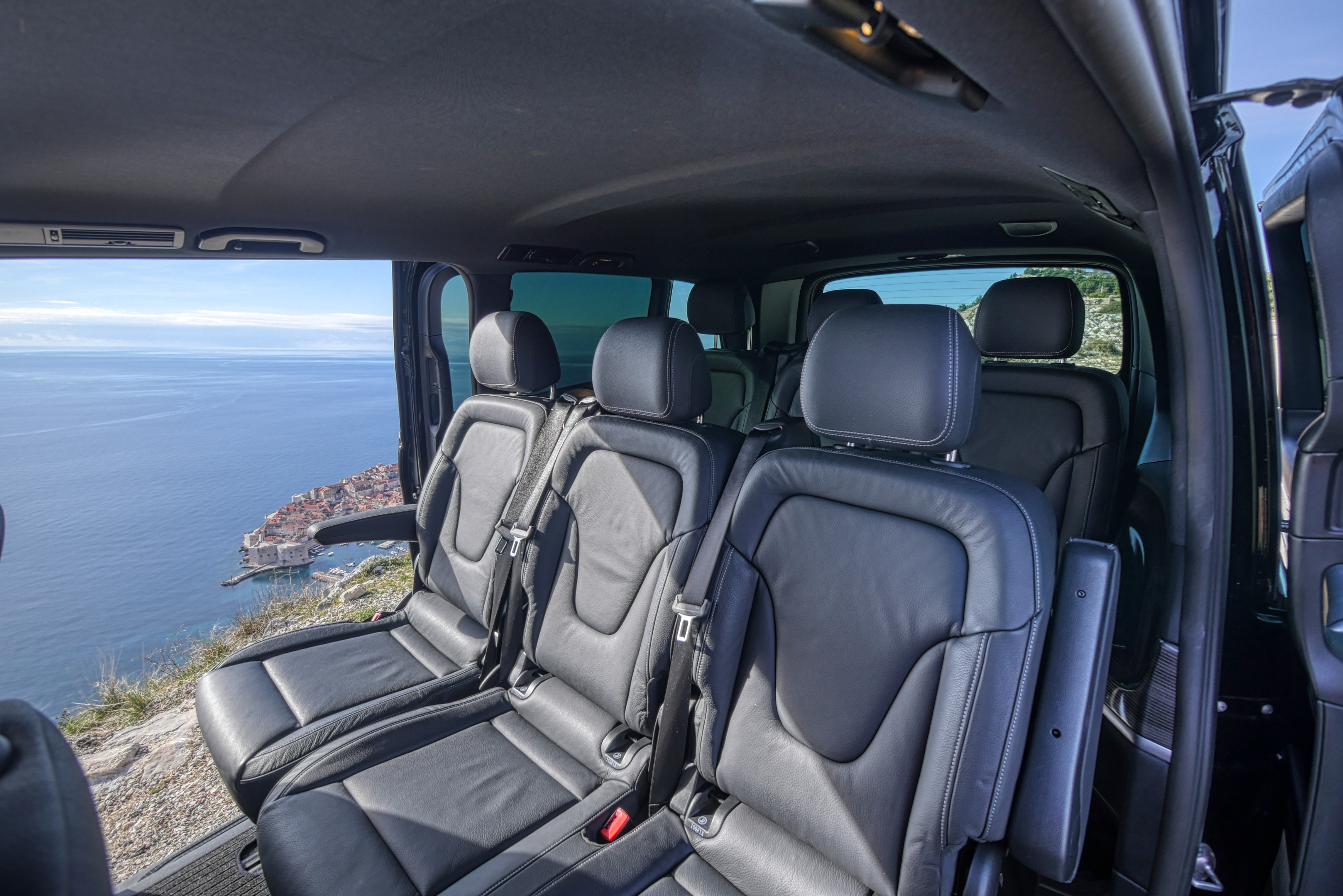
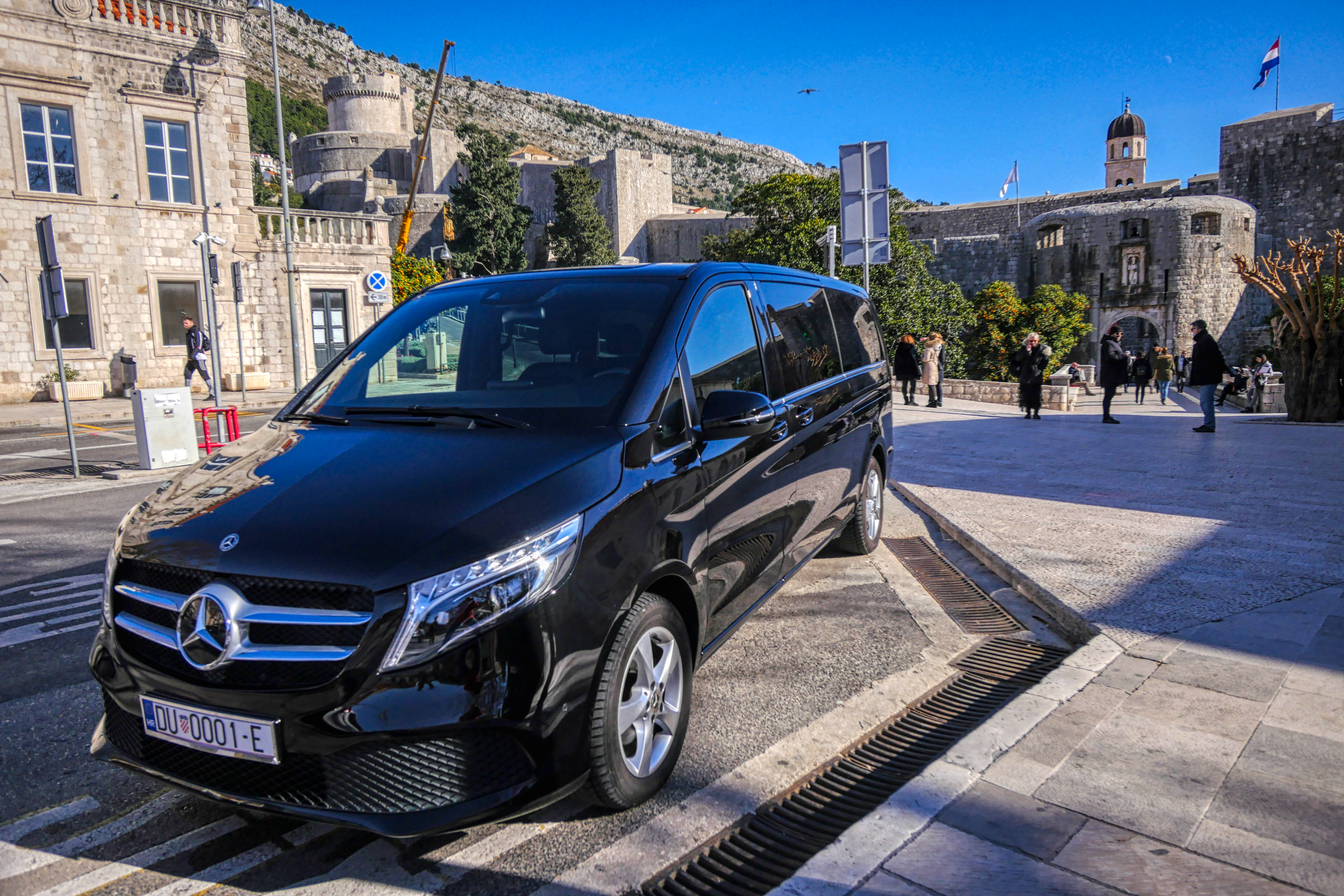
Mercedes at your accommodation. Coffee and the day's route over the first kilometre.
Park near the Riva. Brief orientation before walking into the palace from the seafront.
Substructures, Peristyle, Cathedral of St. Domnius, Temple of Jupiter. Optional licensed local guide.
Quieter konoba a few streets back from the seafront, booked away from the cruise crowds.
Marjan hill walk, Bačvice beach swim, or back-streets and Fruit Square wander. Pick one or do a little of each.
Fifteen minutes south of Split, the UNESCO-listed island town of Trogir — a quick walk and a coffee.
Motorway or coastal road back south, with one quiet swim stop along the way if the weather plays.
Back at your accommodation in time for a late dinner.
Tiered rates: one price for 1–3 guests in an E-Class, another for 4–7 guests in a V-Class. The price is for the whole vehicle, not per person.
Generic reasons help no-one. Here's what specifically sets this trip apart from a coach tour or a self-drive — for this destination, on this route.
Motorway up, coastal road back — you see two very different Dalmatias on the same day.
Arrive in Split by 10am, before the day-cruise traffic builds up around the palace.
Split's palace is dense — 1,700 years of layered history. A licensed guide is worth every euro for first-timers.
Most travellers think Split needs a sleepover — it doesn't, if you start early and have a private car waiting.
Nearly three decades on the same coastline. The same operator runs nine boats and the same office takes every call.
Real reviews from travellers who have done exactly this trip. We publish them unedited.
"Did the Split & trip with Boat Dubrovnik and it was hands down the highlight of our holiday. The driver knew every viewpoint and every place to stop. Worth every euro and more."
"Five-star service from first email to drop-off at our hotel. Pace was perfect, English perfect, knowledge of the area exceptional. Booked their boat tour for the next week too."
"We're already planning the next trip back. The flexibility of having our own driver — stopping for photos, changing the schedule mid-day, asking for a slower lunch — was the best part."
Going further still? Add Krka on the way back. Want islands? Korčula by Land trades motorway for ferry.
Cascading travertine waterfalls, wooden walkways through karst landscape and a boat ride to the medieval Visovac monastery on its island in the lake.
Marco Polo's birthplace by road and a short ferry. The fish-bone street plan of Korčula old town, a vineyard lunch on Pelješac, Ston's salt walls on the way back.
UNESCO Kotor, baroque Perast and the man-made island of Our Lady of the Rocks. The coastal road that ranks among the most scenic in Europe.
The questions guests most often ask us about this specific trip. If yours isn't here, write to us — we'll add it.
Send your date and group size. We'll come back with a tailored offer, pickup time and a draft schedule for this trip.